
Legal Platform AI: The Answer to the Digital Onion?
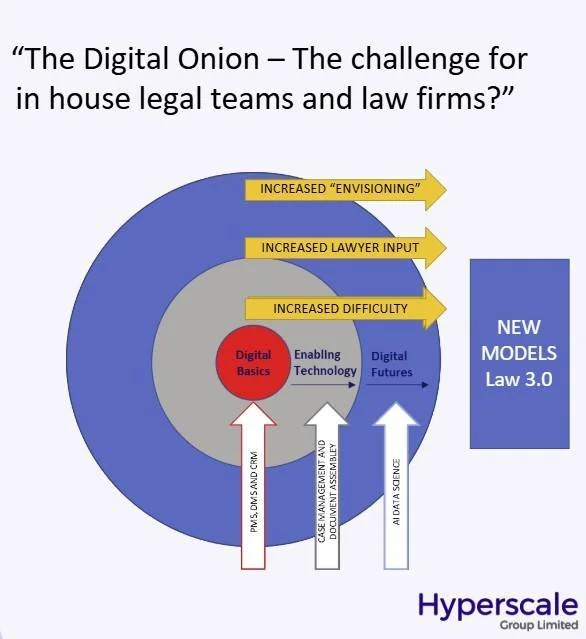
Hyperscale Group’s Digital Onion has, for some years, served as a useful framework for understanding the efficiency challenge facing full service law firms. For those unfamiliar with the concept, imagine three concentric circles. The innermost circle represents digital basics - practice management systems, document management, email management. These are the technologies that a small number of IT professionals can deploy and maintain, yet which deliver benefits to hundreds, sometimes thousands, of people across a firm. The effort-to-impact ratio here is, in pure numerical terms, highly attractive and deliverable which is why many firms have concentrated on this area.
The second circle represents enabling technologies - case management systems, document automation tools, workflow platforms, and the like. These sit closer to the actual delivery of legal work and require greater engagement with legal teams to implement successfully. The benefits are meaningful, but the deployment is more complex and the audience narrower. Skills and resource are often stretched with projects being resource intensive.
The outer circle is where disruptive technologies live - artificial intelligence, data analytics, and predictive tools. These are the technologies that, when applied well, deliver transformative value. They get under the skin of legal work. They change how lawyers think, advise, and operate. But they are also the hardest to deploy. They require a deep understanding of legal process, close collaboration with legal teams, and a level of ongoing development that can be difficult to sustain. No firm has the level of resource to improve every team it wants to help.
The Efficiency Paradox
And here lies the problem - what might be called the efficiency paradox of the digital onion. The technologies that benefit the greatest number of people with the least effort sit at the centre but these don’t really help the delivery of legal work itself. The technologies that deliver the greatest value in terms of legal work sit at the edge and get less attention. Most law firms, for entirely understandable reasons, have historically directed the majority of their attention and resource towards the inner circle. Large-scale IT deployments that serve the whole firm are easier to justify, easier to govern, and easier to measure. It also avoids working with busy lawyers who have erratic client demands which also makes the projects in the outer circles harder to deliver.
The result has been a structural imbalance. Firms have become highly capable at deploying digital basics, a little capable at enabling technologies, and - with some notable exceptions - relatively limited in their ability to deploy disruptive technologies at pace. The outer circle has remained frustratingly out of reach for the majority especially when trying to help a large number of teams. Agonising over how to solve this has consumed innovation teams across the profession for years. For many they have been “outgunned” by only having a small innovation or business transformation team compared with multiple legal teams.
There have been partial solutions. No-code platforms have lowered the barrier to workflow automation. Pre-configured legal technology products - Avail and Orbital being well-known examples in the property space - have demonstrated that solutions tailored to specific legal tasks can be deployed quickly and deliver immediate value. But these solutions have been limited in number, and insufficient to address the underlying structural challenges of a full service firm.
The Platform AI Shift
That picture is now changing - and changing quickly. The emergence of highly capable, legal AI platforms has begun to alter the fundamental economics and logistics of the digital onion in two important ways.
The first is what might be called the democratisation of the outer circle. Tools such as Harvey, Legora, Jylo, and Aria - alongside the major publishers' AI offerings including Thomson Reuters Co-Counsel and LexisNexis Protégé - are placing genuine transformational capabilities directly in the hands of lawyers. A fee earner can now build a workflow, leverage a database/vault, draft a complex document, or analyse a portfolio of contracts without waiting for a large-scale IT project to be scoped, approved, and delivered. The outer circle of the digital onion, previously accessible only through lengthy and expensive deployments (even with specific legal AI products), has become navigable by lawyers themselves.
This is a profound shift. For the first time,(once the relevant platforms have been rolled out) the people who understand legal work most deeply - the lawyers - are in a position to drive their own transformation without being dependent on large business services teams to do it for them. The innovation is distributed, not centralised.
The second shift is the declining relevance of the point solution. For many years, the market response to the digital onion problem was a proliferation of narrow, task-specific tools - each doing one thing well, each requiring its own procurement, implementation, and maintenance cycle. These tools delivered value, but they also created complexity, cost, and fragmentation. The technology stack of a progressive law firm could easily run to dozens of discrete products, many of them performing overlapping or adjacent functions. The document systems market with multiple word add-ins is a great example.
The economics and sustainability of that model are now under serious pressure. When a single AI platform can handle document drafting, legal research, contract analysis, client-facing Q&A, workflow automation, knowledge management and more - and do so at a level of quality that was unimaginable even two years ago - the case for maintaining a long tail of point solutions becomes increasingly difficult to justify.
What does the Future Tech Stack Look Like?
This raises an important and timely question: what does the optimal law firm technology stack actually look like in the coming years? There are many views, and the answer will inevitably vary by firm type, size, and practice area. But a compelling case can be made for a model that is, in its essentials, relatively lean.
Microsoft's productivity suite - Outlook, Word, Teams - remains foundational. A Document Management System continues to serve as the firm's institutional memory and data repository. A Practice Management System drives the financial and operational infrastructure (albeit increasingly firms seem to prefer deploying dashboards rather than the systems themselves as lawyers only need a few key data points to do their job). And then, layered across everything, a powerful Legal AI platform which handles the intelligent, value-generating work that lawyers actually need to do.
In this model, lawyers are not passive consumers of technology deployed to them by others. They are active participants in shaping how that technology works for them. They build, they iterate, they improve - and they do so without needing to submit a business case to a central IT function. It does also raise a key question about the role of KM and many KM teams are now rising to this challenge Knowledge Management 3.0 – How to succeed in a world of AI — Hyperscale Group Limited
A Closing Thought: What Comes Next?
It would be remiss not to acknowledge that the pace of change in this space makes almost any prediction provisional. The AI landscape is evolving by the day and week, and one of the most significant emerging developments is the rise of autonomous AI agents - tools capable of taking sequences of actions on behalf of a user, rather than simply responding to individual prompts. The growing focus on agentic AI, with platforms such as Claude Cowork making significant inroads in this area, raises an intriguing question: could this accelerate the shift to platform AI as a core tech stack component even further? Many suppliers (even Microsoft and Google) are recognising this and are increasingly collaborating.
If the digital onion is and had been a useful way of articulating a problem. Legal Platform AI may well be the answer the profession has been waiting for.
Hyperscale Group are a Technology, Digital and Operational Advisory and Implementation Business with over 25 years plus deep market experience. We work for In-House teams and Professional Services Firms all around the world and support them developing and implementing their strategies. We help In-House Legal Teams make the right things happen.
Our Experience: Click here - Our Services: Click here - Client Testimonials: Click here
How We Work: Click here
For more information, please contact dereksouthall@hyperscalegroup.com